

Espresso Machines - The Best Espresso Makers in the UK
If you're looking for the best coffee experience, you can't beat an espresso machine. They are an act of passion, but they also give you complete control over your coffee.
They usually include an espresso tamper to flatten the grinds and steamer to froth the milk for cappuccinos and lattes.
1. Stovetop
We offer a variety of stovetop coffee makers to aid you in making a fantastic cup. In the UK, approximately 98 millions cups of coffee are consumed each day. Also known as moka pots, these devices make use of pressure to produce an espresso-like cup of coffee without the need for messy filter papers. They are a simple and easy-to-use device that can be used to enhance any coffee and can be combined with milk to make cappuccinos or lattes.
The lower chamber of the moka pot is filled with hot water. The coffee beans are placed in a basket, which is between two pipes leading to the upper chamber, where the brewed beverage will be served. When the water is boiling in the bottom, it pushes itself through the grounds under high pressure and seeps up into the upper chamber where the aromas are released to you to enjoy. The result is a rich aromatic coffee that can be consumed by itself or mixed with milk and sugar.
When you are buying a mokapot the most important thing to consider is the unit's capacity. It is important to make sure that the dimensions of the bottom chamber and the capacity of the basket is sufficient for your needs as larger units will require a longer waiting time, whereas a smaller model might not be able to build up enough pressure. We recommend that you also look at the material the machine is made from. Stainless steel machines are more durable and sturdy but they can cost more.
Other considerations are whether the appliance can work with the source of heat you prefer (gas or electric) and any additional add-ons you might have, such as steamer wands for milk that can be used to heat and froth milk for lattes and cappuccinos. It is also worth considering the amount of cups you can prepare in one go, as this can be a great method to determine the best size unit for you.
We would also recommend that you check the base of the moka pot to ensure it fits on your burner. We discovered that certain models, such as the Stelton collar espresso maker, had a base that was narrow and were difficult to place on a gas stove. On the other hand, larger bases, such as those of the Bialetti Venus and London Sip stovetop espresso makers, provided better results. We also preferred models with thicker walls because they were found to carry heat more efficiently and stop it from sputtering too fast.
2. Capsule
In a similar vein to stovetop models there are capsule coffee machines that make espresso, cappuccinos and so on using pods. If you don't like messing with grounds, cleaning and brewing this is the ideal solution for you.
You'll need to purchase the coffee pods separately. There are a variety of brands available, including Nespresso Dolce Gusto, and Tassimo. There are also different sizes to choose from and you can tailor the size of your beverage and coffee style to your preference. The smallest model is the Nespresso Essenza Mini, which is perfect for small spaces and can make one cup at one time. A larger model is available that can also accommodate larger cups however it will cost more.
For a more sophisticated choice that also makes better tasting coffee The Illy Iperespresso is a chic shortcut for coffee snobs. It's not the cheapest machine, but it produces an excellent cup of coffee. It's also easy to use. It has a clever feature that lets it automatically alter its settings in accordance with the brand of pods it is using. This makes it one of the most adaptable machines we've seen.
If you're interested in exploring the entire range of drinks you can prepare with a pod-based coffee maker, it's worth looking for a model that comes with a milk carafe. This will allow you to play around with cappuccinos and lattes. You can still make these popular drinks using a capsule maker without a milk cup, but it's more than a hit and miss affair.
If you're thinking of buying a capsule coffee machine be sure that it's marked as compatible with ESE pods. This typically means it has a basket or adapter to fit these smaller pods. Some of our models have this feature. This means that you can use the machine with Nespresso compatible pods, and also Dolce Gusto and Tassimo pods.
3. Manual
These are manual espresso machines for those who are a bit more discerning. They look similar to the OG espresso machine, which was invented in Italy in the early 1900's. They are operated by manually pumping water through a portafilter and locking it, after which pushing water under 9 bars of pressure to create an espresso shot.
Manual espresso makers are generally more labor-intensive than capsule machines. You must heat the water separately, pour it into the chamber over pods or coffee that has been ground up and then press the lever or plunger down to create pressure and force the liquid into the cup. This method of operation can be quite messy, time consuming and sometimes a bit difficult to get right however the result is well worth the effort.
Some of the more modern models like the Flair 58 and the Sage The Barista Touch Impress have taken a different approach to make it easier to control, they have utilised an electronic temperature controller known as a PID (Proportional-Integral-Derivative). This technology is used in high-end immersion circulators as well as toasters. It is designed to stabilise brew boiler temperatures. This is a fantastic way to take away a lot of the guesswork surrounding the optimal temperature of brewing.
There are a few major brands that make manual espresso makers, the likes of Rancilio and La Pavoni are familiar names to those who have worked in the cafe or coffee shop. They make the massive commercial espresso machines that have three or two heads that are found in coffee shops, but in 1997, they introduced the Silvia, a semi-automatic manual espresso machine that comes with a few bells & whistles that can take some of that hassle out of brewing.
Fully automatic espresso machines will do all the work for you. They'll grind the beans and then tamp them up, pull the shot, and even steam your milk. However, they can be costly so you will need a good bank balance to afford one.
4. Semi-Automatic
If the idea of replicating an espresso shot from your favorite café at home strikes a chord and you want to replicate it, then a semi-automatic coffee machine is the right choice for you. These machines allow you to adjust your preferences over time and dial in your espresso drinks according to your mood at any given time.
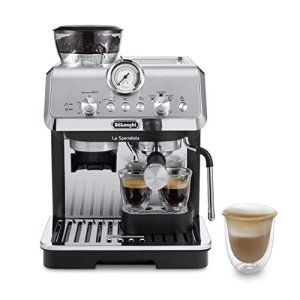
These machines include a portafilter as well as steam wand. These machines share a similar brewing process to superautomatics, however they require manual steps like grinding the beans and inserting the portafilter. These machines require more skill and knowledge to operate, because the brewing process does not run automatically.
A good semi-automatic will include a portafilter that is removable and a tamper that is capable of compressing the ground coffee inside the portafilter before making. It also allows you to control the amount of water and pressure that is used in the brewing process. This means you can customize your shots to your own preferences, and to the particular type of coffee bean that you are using.
Another feature to look for in a semi-automatic is the ability to adjust the temperature. This feature lets you set the brewing temperatures for your coffee beans according to how they taste. It also helps you avoid temperature fluctuations which is crucial for the boiler that brews the coffee. espresso machines coffeee.uk could vary by up to 20oF between cups if there is no PID controller. This swing can be reduced to 0.1oF by using a PID.
Some of the most expensive models will also include an milk frother to create milk-based espresso drinks. This lets you make delicious cappuccinos and lattes. The frothing jug must have a comfortable grip and a spout to make pouring easy.
It is also recommended to select one that has a removable filter basket as well as an automated dosing system for the ground. You'll be able avoid the manual grinding and tamping yourself. This will make cleaning the machine much easier.